



At this point in life, anything that legitimately moves the needle on energy gets my full attention — I don’t have the bandwidth for things that “almost” work. So when ION Layer — whose patches I’ve been using long enough to trust — released a subcutaneous injection pen delivering energy-boosting NAD+ directly into the bloodstream in seconds, I was already sold before I finished reading the product page.
I took my first dose of NAD+ over five years ago and have worked my way through every delivery method since. Precursor supplements, IM injections, IV drips at wellness clinics, and eventually ION Layer’s transdermal patches, which became my personal favorite until I got pregnant (again). Coming back postpartum, I wanted to see what a lower, consistent daily dose would do — whether I could still get the NAD+ benefits I’d been missing since having baby number two without going straight back to the full patch protocol.
Turns out, the pen has its own answer to that question.
If you’ve been watching the pen from a distance and waiting for someone who’s actually used it to weigh in — then you’ve come to the right place. I’ve done the injections, tracked the results, and lived the protocol. Here’s everything you need to know.
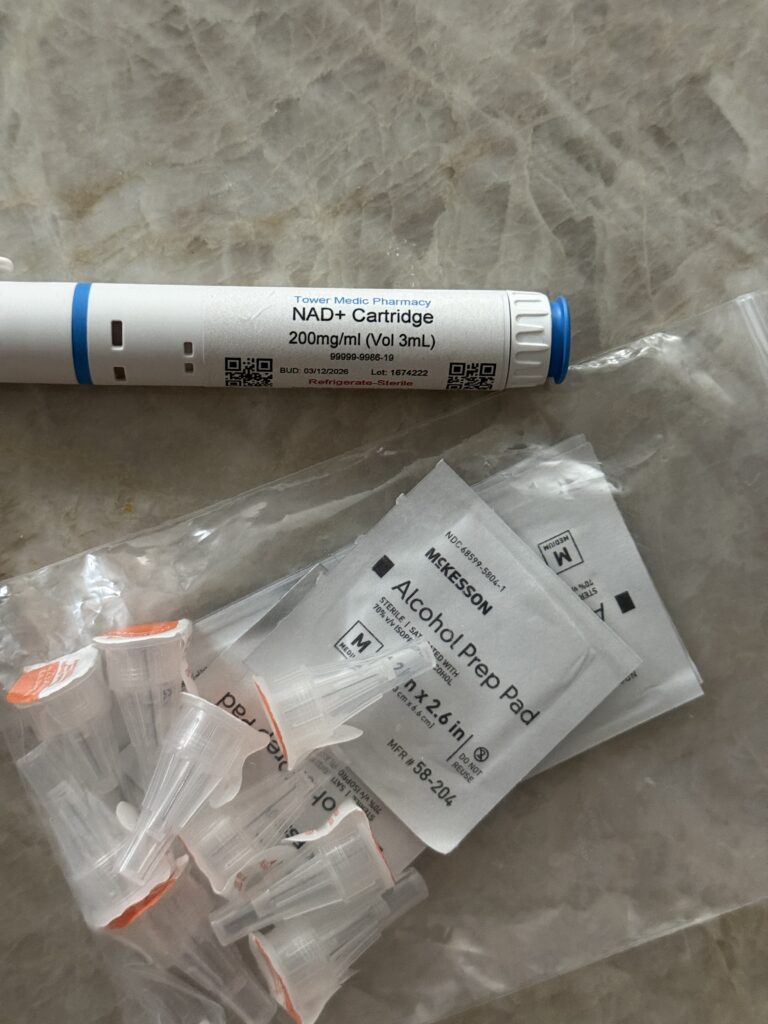
What Is the ION Layer NAD+ Injection Pen?
The pen is exactly what it sounds like — a compact, pre-loaded auto-injector built for at-home subcutaneous NAD+ delivery. Your very own Penjamin Franklin if you will. If you’ve ever seen or used an insulin pen, it’s a very familiar design: small, intuitive, and designed so that injecting yourself feels less like a medical procedure and more like part of a morning routine.
Here’s the thing about NAD+ dosing that most people gloss over: more isn’t always better. There’s a reason high-dose IV bags and 500mg transdermal patches exist — flooding the system with NAD+ has its place, especially for loading phases or when you’re genuinely depleted. But there’s also a strong case for the daily, lower-dose approach. Consistent, smaller doses keep NAD+ levels steady without the peaks and valleys — and for a lot of people, that sustained baseline is where the real benefits live. The Ion Layer pen delivers exactly that: 50mg per injection, directly into the bloodstream, no clinic required.
What’s In The ION Layer Pen Kit
Here’s what comes in the kit:
- 2 Injector Pens, preloaded with 500 mg NAD+ per pen
- micro-needles
- Alcohol wipes
- Full instructions
A few things worth noting before we get into the experience: this is a compounded prescription product — regulated, pharmacy-grade, and about as far from a sketchy gray market website as you can get. ION Layer handles the clinical clearance entirely online, which means no doctor’s office, no phone tag, no waiting room, no wasted hours. It’s also LegitScript-certified, which I’ll be honest, was one of the first things I checked. When you’re injecting something into your body, sourcing isn’t a detail you skip.

The Prescription Process (Easier Than You’d Think)
Because ION Layer’s NAD+ is an injectable compound, it requires a prescription — same as the patches. But if you’re picturing a doctor’s appointment and a pharmacy run, it’s nothing like that. ION Layer has made the process about as frictionless as it can get:
- Purchase the pen kit on ionlayer.com
- Complete a short intake form after checkout — five minutes, maybe less
- Upload a valid ID
- ION Layer’s network of physicians reviews and approves your order
- Ships from their LegitScript-certified pharmacy within 3–4 business days
- Tracking email lands in your inbox as soon as it’s on its way
No phone calls. No waiting rooms. No explaining yourself to anyone. The entire thing happens seamlessly, which — if you have small children and approximately zero uninterrupted hours in your day — is the only kind of process worth doing.
How to use the Ion Layer Pen — Step-by-Step
The instructions that come in the kit are clear and straightforward. But I’ll walk you through what to expect for your first injection.
Before you start: make sure your package arrives cold and your pen stays refrigerated when not in use. When you are ready for your injection, take the pen out of the refrigerator and allow it to come to room temp. Just remember you do not want it to stay at room temp after you use it.
Step 1 — Assemble
Attach a fresh micro-needle to the pen and screw it on firmly. Remove the outer cap and place it to the side. You’ll see one more narrow cap that covers the needle – keep this on for now.
Step 2 — Set Your Dose
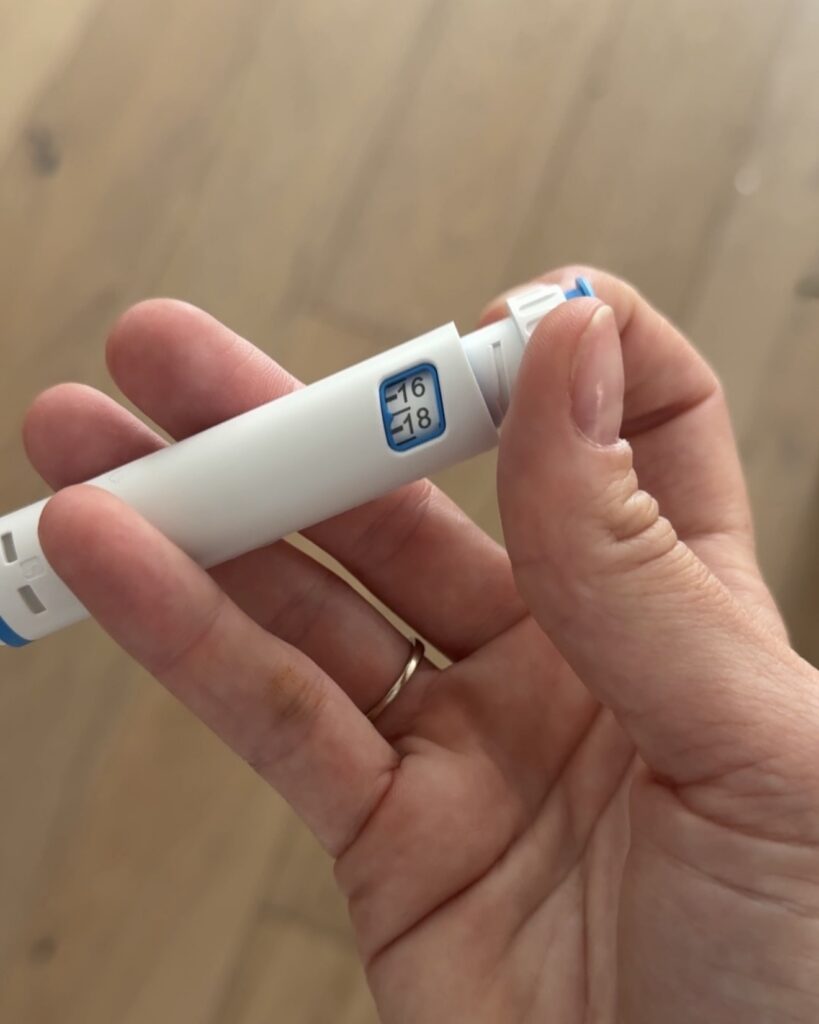
Set your dose by twisting the base of the pen until the dose meter reaches your preferred number of units (I’ll explain dosing next.)
Step 3 — Inject
When you’re ready to inject, remove the narrow needle cover to expose the needle. Pinch the skin at your injection site. The recommended areas are: lower abdomen (at least 2 inches from your navel), outer thigh, or upper glute. Insert the micro-needle at a 45-degree angle into the skin. Press the blue end of the pen to inject slowly until the unit dial goes down to zero – you’ll hear clicks. Hold for 3-5 seconds before withdrawing the needle. Replace the needle cap and dispose of it in a sharps bin.
Store the pen in your refrigerator and dispose after 30 days.
Ion Layer Pen Dosing Protocol
ION Layer’s recommended protocol is straightforward: 50mg injections (25 units) on a 5-days-on, 2-days-off schedule. Each pen contains 500mg total, giving you roughly 10 injections per pen — and with two pens in the kit, you’re set for a full month.
That said, I didn’t start at 50mg. My personal approach with anything injectable is to go low first, see how my body responds, and work up from there. I started at 25mg for the first week and increased to 50mg in week two with zero issues — no full-body flush, no sensitivity, nothing to report. It’s always easier to work up than to backtrack, and starting lower gave me confidence in the protocol before committing to the full dose.
Two things I’ll flag because I wish someone had told me: figuring out units was the only mildly confusing part of this whole process. I accidentally tossed the instruction card early on and had to dig around on ION Layer’s website to confirm I was dosing correctly. Another thing, do it in the morning. Taking an energizing compound at night can, well, energize you.
Here’s a little cheat sheet:
*Alternate Dosing Options*
- 25mg = 12 units
- 50mg = 25 units
- 75mg = 37 units
- 100mg = 50 units
What It Actually Feels Like
Let’s address the thing everyone wants to know: yes, there is a needle. No, it is not dramatic. I say this as someone who has had full IV bags of NAD+ and genuinely dreaded the first time I did this myself.
The micro-needle is ultra-fine — we’re talking insulin pen territory, not a blood draw, not a clinic injection. The experience is a click, a quick pinch, and then a brief warmth at the injection site that fades within seconds. That warmth is just your body registering the compound entering the subcutaneous layer — it’s a normal physiological response, not a warning sign.
Prior to trying the Ion Layer pen, I got a 100mg shot at a wellness clinic. I had a slight reaction immediately. Full body flush and a wave of nausea – very common with NAD+ at higher doses. For reference, I’m a 135lb woman – and with both 25mg and 50mg shots from my pen, I never experienced this type of reaction.
If there’s any sting, it’s almost always because the solution was still cold. Let the vial sit at room temperature for five to ten minutes before injecting and that largely disappears. Some people notice mild redness or a small bump at the site afterward — totally normal, clears within the hour, and it helps to switch injection sites. The lower abdomen, outer thigh, and upper glute are your rotation points. I find that it’s more effective with the abdomen, and I make sure to not inject in the exact same spot the following day.
For most people, the needle is typically the thing they are initially nervous about.
Week 1
ION Layer is upfront about this: some people feel nothing in the first week, and I was one of them. After five consecutive days at 25mg, I didn’t notice much of a shift in energy or mental clarity — nothing like what I’ve felt in the past with the patches or higher-dose IV sessions. But I wasn’t surprised, and I wasn’t discouraged. I knew going in that consistency was the variable that mattered most, and that the lower starting dose was always going to be a slow burn. I stayed the course.
Week 2
With no negative side effects from the lower dose, I bumped up to 50mg — and this was the week things started to move. Nothing dramatic, but noticeable in the way that actually matters: less mom brain, no 3pm wall, and a recovery from multiple rough nights that felt faster than it had any right to be given my six-month-old’s current feelings about sleep. I could handle the full weight of the day without feeling completely hollowed out by 7pm. That’s not nothing. That’s actually everything.
Weeks 3–4
By weeks three and four, something had shifted — and this time I could actually feel it stacking. The mom brain that had been quietly stealing my personality for months was noticeably quieter. I felt sharp. Not fake-sharp, not third-coffee-of-the-day sharp — actually, genuinely mentally present in a way that felt almost unfamiliar. I’m running on the least amount of sleep I’ve had since before I had kids, keeping up with a toddler and a six-month-old simultaneously, and somehow not dissolving into the couch by 2pm. That alone felt worth writing about.
But the thing I wasn’t expecting — and honestly the thing that made me want to tell everyone I know about this — was my mood. I was happier. Like, noticeably, unpromptedly happier. I had some mood issues after this baby, and I’m not here to make any clinical claims about what NAD+ does or doesn’t do for that. But there is a lightness that came in around week three that I hadn’t felt in a long time, and I’m not willing to write it off as coincidence. Something shifted. My husband noticed before I said anything. Make of that what you will.
I kept my dose at 50mg on ION Layer’s recommended 5-on, 2-off schedule and have zero desire to change it. Starting lower was the right call — it’s always easier to work up than to backtrack, and I think I landed exactly where I’m supposed to be.
ION Layer Pen vs. ION Layer Patches — The Real Comparison
Do both have a place in my wellness routine? Yes. But for different reasons. Let’s break down the difference between Ion Layer’s transdermal patches and Injector Pen:
The Patch
- Iontophoresis delivery — a mild electric current drives NAD+ through the skin
- 500mg per patch, gradual sustained release over 14 hours
- Can do a loading dose of a patch every other day, or one per week
- No needles, lower psychological barrier to entry
- Commitment: more than half your day wearing it — overnight is the move for most people
- Great for beginners or anyone who wants to start without any injection element
The Pen
- Subcutaneous injection — delivered directly into the bloodstream in less than 60 seconds
- 10 injections per kit, 5 days on / 2 days off protocol
- Higher per-dose precision, near-100% bioavailability, completely flexible timing
- Requires comfort with self-injection — the psychological barrier is real for some, even if the physical experience is minor
- More travel-friendly — small cooler for vials, pen in your bag, done
After my experience using both, I’ve found my perfect “protocol” which involves both the pen and patches.
My protocol going forward is intentional. For one month I’ll “load” with the ION Layer transdermal patches — 500mg each, every Sunday. And if I’m feeling extra depleted at any given month, I’ll do their recommended loading dose of one patch every other night for 12 days (6 patches.)
Then for maintenance (following month), I move to the pen: 50mg injections, 5 days on, 2 days off. Lower dose, consistent rhythm, built into my week without a second thought. After a full cycle of that, I take a month off entirely. Reset, and start again.
The Bottom Line
Here’s my honest take: the pen isn’t a replacement for the patches — it’s a different tool entirely. Where the patches deliver a 500mg hit that you feel like a freight train by morning, the pen is quieter, more consistent, more maintenance. Fifty milligrams every day doesn’t announce itself. It just works, slowly and steadily, until one day you realize you haven’t lost your train of thought in two weeks and you’re somehow keeping up with a six-month-old and a toddler on four hours of sleep without completely falling apart.
That said — consistency matters more with the pen than with anything else I’ve tried. This isn’t a patch-it-and-forget-it situation. You have to show up for it, and it shows up for you. By the end of week two, the NAD+ benefits were undeniable for me. Not dramatic, not overnight — just a steady, cumulative shift that I’d put up against any oral supplement I’ve ever tried.
I’ll be alternating between the pen and the patches every two to three months going forward. Each has its own job. The patches load. The pen maintains. Together they’ve become the protocol that I’ll be doing for the foreseeable future.
And look — I tell every mom I know that NAD+ was basically invented for tired parents. Not because it’s a magic fix, not because it erases the 3am wake-ups or the mental load or the fact that you haven’t finished a hot cup of coffee in eighteen months. But because when your cells actually have what they need to function, everything else gets a little more manageable. The fog lifts. The patience comes back. You remember who you were before you were someone’s mother, running on empty and calling it fine.
That’s what this did for me. And that’s why I’m not stopping.
FAQ — ION Layer NAD+ Injection Pen
Prices start at $399/month and you can get 20% off your purchase with code THEHIVE
NAD+ is not recommended for those who are pregnant due to lack of safety data. If you are breastfeeding, you will be declined the product during your medical intake. There’s very few studies done on lactating mammals and NAD+ supplementation – and although they show positive outcomes, the research is still relatively new. It’s always important to talk to your doctor and get clearance before trying anything while breastfeeding or pregnant.
Some people notice a subtle energy or focus shift within the first few days. Most experience the cumulative effect building over 1–2 weeks of consistent use. Results vary based on your baseline NAD+ levels, sleep, and stress.
5 days on, 2 days off. Each injection can be adjusted to however many units you want – although the company recommends 50mg (25 units) per injection.
Yes — it’s a compounded injectable, which makes it a prescription product. But ION Layer handles everything: you complete a short intake form online, upload ID, and their network of physicians reviews and approves your order before it ships.
The patches use iontophoresis — a mild electric current that drives NAD+ through the skin over 14 hours. The pen delivers NAD+ subcutaneously in 60 seconds, with near-100% bioavailability. Different delivery method, different use case.





Comments +